
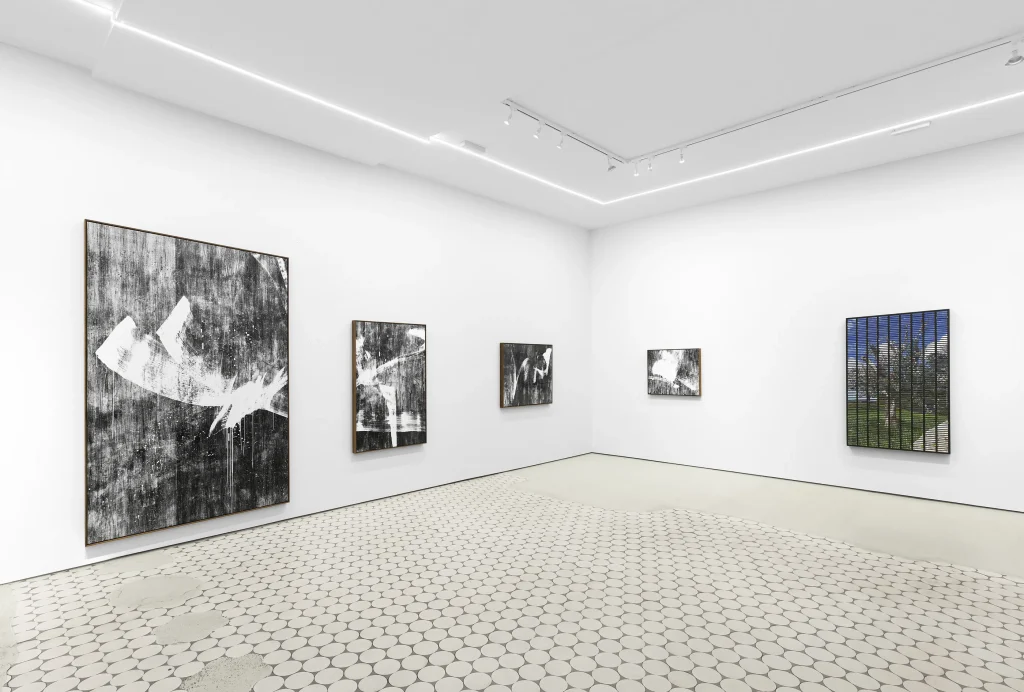
We are pleased to announce Casado Santapau’s represented artist Gregor Hildebrandt’s new exhibition:
Park by POCO
Gregor Hildebrandt
Opening: Thursday, September 10th, 6 – 10 pm
Exhibition: September 10th – October 9th, 2026
With Park by POCO, Gregor Hildebrandt presents a new body of work that builds upon his engagement with the material traces of cultural memory. The exhibition takes the garden as both a point of departure and a conceptual framework: a space of growth, transformation, accumulation, and renewal. When one thinks of a garden, countless literary heroes and heroines come to mind who explored it as such a metaphor: from Adam and Eve to Blixa Bargeld, or, less obviously, Candide. Hildebrandt is less interested in cultivating physical gardens than in cultivating the gardens of the soul – music, books, and film – excavating his references from obscurity.
In the background of Park by POCO is Martin Šulík’s film The Garden, whose physical remains become the material foundation of the exhibition. It fills the walls and windows of the gallery, transformed into a sanctuary of its own by Hildebrandt, rendered as illegible as possible through processes of destruction and reconstruction. Indeed, a VHS tape can hardly hope for a more meaningful afterlife than being ripped apart in Hildebrandt’s studio.
Although the contents of this recorded cultural memory are less significant for Hildebrandt than their very existence, the garden remains a fitting allegory for his treatment of analog media: a practice of tending, cultivating, and transforming what would otherwise decay and disappear. Further into the gallery, a vinyl shelter emerges within a shield of inaudible sound in the form of an expansive, site-specific bar installation, where visitors are invited to gather.
Every garden accumulates traces of what passes through it: desired and undesired, useful and useless, beautiful and ugly. In the same way, Hildebrandt’s works become repositories of potential and meaning, storing their contents much like tapes, cassettes, paintings, and sculptures. Like his raw material, the garden grows through attention and care, filling itself with familiar inhabitants – apples, philosophers, and musicians.
Yet such a retreat is nowhere to be found in Wedding’s Soldiner Kiez, where Hildebrandt’s studio is located. Visitors first encounter a far more mundane question: where to find a parking space. The answer is POCO. A parking lot may seem like an unlikely landscape in contrast to a blooming garden evoking art’s intangible riches. From Rousseau to Joni Mitchell, many have lamented the loss of beauty paved over by civilization. They all arrive at a similar conclusion: that the mystical place we seek is ultimately within us. For Hildebrandt, it is in the reality of his material and its traces.