
Born in 1974 in Leuven, Belgium
Living and working in Madrid, Spain and Santiago, Chile.
Solo Exhibitions
- Museo de Arte Moderno de Bogotá (MAMBO), Bogotá, Colombia. (Curator Eugenio Viola)
- HIPERASIA, Casado Santapau Gallery, Madrid, Spain.
- Geometría y Territorio, Galería Livia Benavides, Lima, Peru
- Construir una ciudad, El Programa, Ciudad de Guatemala, Guatemala.
- Atacama, MAC, Santiago, Chile.
- Proyecto Colchane, Patricia Ready Gallery, Santiago, Chile.
- Los olvidados, Casal Solleric, Palma de Mallorca, Spain.
- Atacama, ICPNA Lima, Perú.
- El ladrillo, MACBA, Buenos Aires.
- ATACAMA, Galería Casado Santapau, Madrid, Spain.
- La Construcción del Poder, Museo Extremeño e Iberoamericano de Arte Contemporáneo (MEIAC), Badajoz, Spain.
- El Invernadero Rojo, Centro de Arte Conde Duque, Madrid.
- El Ladrillo, Galería RGR, Ciudad de México.
- Galería Patricia Ready, Santiago, Chile.
- Fundación DIDAC, Santiago de Compostela, España.
- Transformers (with Dario Escobar), Museum of the Americas, Washington DC, USA.
- El Ladrillo, Galería Casado Santapau, Madrid, Spain.
- Museum DKM, Duisburg, Germany.
- Ultramar Sur, Fondazione Pastificio Cerere, Rome, Italy.
- Galería Baginski, Lisboa, Portugal.
- El ladrillo, Sala de Arte Muralla Bizantina, Cartagena, Spain.
- Progress, Centro de Arte Wilfredo Lam, La Habana, Cuba.
- Black Tools, The 9.99, Ciudad de Guatemala, Guatemala.
- Progress, Galería Marta Cervera, Madrid, Spain.
- Proyecto Lanz, Flora Ars+Natura, Bogotá, Colombia.
- Progress, Museum of Contemporary Art (MAC), Santiago, Chile.
- Postdictadura, Centro de la Imagen, Lima, Perú.
- Ultramar Sur, Paco das Artes, Sao Paulo, Brazil.
- Máxima tensión, Galería Baro, Sao Paulo, Brazil.
- Santiago dérive, DKMFoundation, Duisburg, Germany.
- Proyecto Americanidade, Museum of Contemporary Art, Fortaleza, Brasil.
- Proyecto de Arquitecturas Revestidas, Metropolitan Cultural Center, Guatemala City, Guatemala.
- Santiago dérive, KBKGallery, México City, México.
- The Sanhattan Project, Prometeo Gallery, Milano, Italy.
- Objetos en Transito, Sala Gasco, Santiago, Chile.
- Queer tools, Museum of Modern Art, Chiloé, Chile.
- Patrick Hamilton, Museum of Contemporary Art, Valdivia, Chile.
- Tools, Posada del Corregidor Gallery, Santiago, Chile.
Group Exhibitions
- Casa de América, Madrid, España (Curator Rene Francisco Rodríguez)
- Galería RGR, Ciudad de México, Mexico.
- Esto es lo verdadero, Museo Extremeño e Iberoamericano de Arte Contemporáneo (MEIAC), Badajoz, España. (Curator Adonay Bermúdez)
- The red letter, ARTIUM Museo Vasco de Arte Contemporáneo de Vitoria-Gasteiz, España. (Curator Iñaki Martínez)
- Quimeras: la bienal del 74 como laboratorio social del presente, Museo de Arte Contemporáneo (MAC), Santiago, Chile. (Curator Eugenio Viola)
- Esto es lo verdadero, Centro Cultural de España en México, Ciudad de México (Curator Adonay Bermúdez)
- Después del Edén, Galería RGR, Ciudad de México. (Curator Gabriela Rangel)
- Formas Políticas: escultura contemporánea chilena 1960-2000, Museo Nacional de Bellas Artes, Santiago, Chile.
- El cuarto paso, El programa, Ciudad de Guatemala, Guatemala. (Curator Javier Payeras)
- Jugar con los ojos cerrados, 100 años de Surrealismo, Galería RGR, Ciudad de México. (Curator Gabriela Rangel)
- Lejos, muy lejos, Matucana Cultural Center, Santiago, Chile.
- Trabajo en equipo, 30 años del CGAC, Centro Galego de Arte Contemporáneo, Galicia, Spain.
- Un Viaje Extraordinario. El efecto de los Océanos, Centro Centro, Madrid, España.
- Converge 45 2023 Biennial Social Forms: Art as Global Citizenship, curated by Christian Viveros-Fauné.
- Intimate/Outspoken, L’Atlas, Paris.
- Y de pronto no habrá más orilla…, Il Posto, Santiago de Chile, Chile.
- Takeover Mexico, Marión Art Gallery, Ciudad de Panamá, Panamá.
- Exhibition Ciclos, part of Terra, VI Lisbon Architecture Triennale.
- Tiempos incompletos: Chile, primer laboratorio neoliberal, Museo Nacional Centro de Arte Reina Sofía, Madrid, España.
- Viaje al Fin de la Revolución(es), Galería Casado Santapau, Madrid, Spain.
- Gran Sur: arte chileno contemporáneo en la Colección Engel. Sala Alcalá 31, Madrid.
- The Chicago Boy’s Project (El ladrillo), Museo Nacional Centro de Arte Reina Sofía, Madrid, España.
- Ficçâo e Fabricação. Fotografia de Arquitectura após a revolução digital. MAAT Lisboa.
- Summer Show, Galería Layendequer, Tenerife, Spain.
- Lo que ha dejado huellas: Colección GGM, Centro Nacional de Arte Contemporáneo, Santiago, Chile.
- Weapon of Choice, Shiva Gallery @ John Jay College, New York, USA.
- Acts of Sedition, White Box Art Center, New York, USA.
- Space to Dream: Recent Art from South America, Auckland Art Gallery, Auckland, New Zeland.
- Friends with benefits, Galería Layendequer, Tenerife, Spain.
- Traslape, The 9.99, Ciudad de Guatemala, Guatemala.
- Colección MAC: Obras seleccionadas, Museo de Arte Contemporáneo (MAC), Santiago, Chile.
- Colección MAC: Una suma de actualidades, Museo de Arte Contemporáneo (MAC), Santiago, Chile.
- Pero no soy fotógrafo, The 9.99, Ciudad de Guatemala, Guatemala.
- Otros relatos: el despertar de la Historia y el final del storytelling, Centro de Arte La Conservera, Murcia, Spain.
- Dialogues, The 9.99, Guatemala City, Guatemala.
- Beleza?, Centro Cultural Sao Paulo (CCSP), Brazil.
- Grado cero: 10 años de arte contemporáneo chileno, CorpArtes Foundation, Santiago, Chile.
- Beyond the Supersquare, The Bronx Museum of the Arts, New York, USA.
- New York Stories: Twenty Years of ISCP, International Studio & Curatorial Program, New York, USA.
- Territorios fronterizos: La fotografía más allá de la imagen, Matucana 100 Cultural Center, Santiago, Chile.
- Dear Mr. Thanatos, Cristin Tierney Gallery, New York, USA.
- Slow Future, Centre for Contemporary Art Ujazdowski Castle, Warsaw, Poland.
- 30 years of the Havana Biennial, Wilfredo Lam Art Center, La Havana, Cuba.
- Emergency Pavilion: Rebuilding Utopia, 55th International Art Exhibition la Biennale di Venezia, Italia.
- Day by Day, The 9.99, Guatemala City, Guatemala.
- Here we are, from here we go, Arroniz Arte Contemporáneo, México City, México.
- Dirupted Nature, Museum of Latin American Art (MOLAA), Long Beach, CA, USA.
- Coletiva, Baro Gallery, Sao Paulo, Brazil.
- Violent Frames, González y González, Santiago, Chile.
- Ni pena ni miedo, Museo Extremeño e Iberoamericano de Arte Contemporáneo (MEIAC), Badajoz, Spain.
- Now: works from the Jumex Collection, Centro Cultural Cabañas, Guadalajara, Mexico.
- 11ª Cuenca Biennial, Ecuador.
- Dublin Contemporary 2011, Terrible Beauty—Art, Crisis, Change & The Office of Non-Compliance, Dublin, Ireland.
- 6ª Curitiba Biennial, Oscar Niemayer Museum, Curitiba, Brasil.
- La operación verdad, Salvador Allende Museum, Santiago, Chile.
- Proyecto Ideal, Centro Cultural Sao Paulo, CCSP, Brazil.
- Paisaje y residuo, González y González, Santiago, Chile.
- Dirty Kunst, Seventeen Gallery, Londres, UK.
- Planet of Slums, Mason Gross Galleries, Rutgers University, New Jersey, USA
- Proyecto Ideal, Museum of Contemporary Art (MAC), Santiago, Chile.
- El efecto drácula, Museo Universitario del Chopo (UNAM), Mexico City, Mexico.
- Optimismo radical, Josee Bienvenu Gallery, New York, USA.
- Arsenal, Baro Gallery, Sao Paulo, Brazil.
- Spasticus Artisticus, Ceri Hand Gallery, Liverpool, UK.
- 1ª Chile Triennial, Museum of Contemporary Art (MAC), Santiago, Chile.
- Lines of silent beauty, Museum DKM, Duisburg, Germany.
- 10ª Havana Biennial, La Havana, Cuba.
- 2ª Canary Island Art and Architecture Biennial, Tenerife, Spain.
- Großstadtbilder: Works fron the Biederman Collection, Kunstmuseum Heidenheim, Heidenheim, Germany.
- 4ª Curitiba Biennial, Curitiba, Brazil.
- 1ª End of the world Biennial, Ushuaia, Argentina.
- Daniel López Show, Roebling Hall Gallery, New York, USA.
- Contemporary artist from Santiago to Brooklyn, The Rotunda Gallery, New York, USA.
- Light / Art: Mystic Crystal Revelation, Santa Barbara Contemporary Art Forum (CAF), California, CA, USA.
- From the other site/side, Museum of Contemporary Art (MAC), Santiago, Chile.
- Picnic 3, Isola Art Center, Milano, Italy.
- From the other site/side, National Museum of Contemporary Art, Seul, Korea.
- Living for the city, Jack Shainman Gallery, New York, USA.
- 2ª Prague Biennale, Chezc Republic.
- Points of View, Photography in El Museo del Barrio’s Permanent Collection, El Museo del Barrio, New York, USA.
- Contrabandistas de Imágenes: Selection 26 Sao Paulo Biennial, Museum of Contemporary Art (MAC), Santiago, Chile.
- 26ª Sao Paulo Biennial, Sao Paulo, Brazil.
- Produciendo Realidad, Prometeo Foundation, Lucca. Italy.
- Postcards from Cuba, Henie-Onstad Kunstsenter, Oslo, Norway.
- 4ª MNBABiennial, Museum of Fine Arts, Santiago, Chile.
- 8ª Havana Biennial, La Havana, Cuba.
- 7ª Cuenca Biennial, Cuenca, Ecuador.
- L’ Art dans le monde, Les Musées de la Ville de Paris, France.
- 2ª Mercosur Biennial, Porto Alegre, Brazil.
- Magnética, Telefónica Foundation, Santiago, Chile.
- FOB, Gabriela Mistral Gallery, Santiago, Chile.
Selected Collections
- Biedermann Collection-Museum Art.Plus, Donaueschingen, Alemania.
- Centro de Arte Dos de Mayo (CA2M), Madrid, España.
- Centro Gallego de Arte Contemporáneo (CGAC), Santiago de Compostela, España.
- Colección Il Posto, Solari Del Sol, Santiago, Chile.
- Colección Kells, Santander, España.
- Colección Olor Visual, Fundación Ernesto Ventós, Barcelona, España.
- El Museo del Barrio, New York, USA.
- Fundación ArtNexus, Bogotá, Colombia.
- Fundación / Colección Júmex, México DF.
- Fundación Engel, Santiago, Chile.
- Museu da Fotografía, Fortaleza, Brasil.
- Museo de Arte Contemporáneo, Centro Dragao do Mar, Fortaleza, Brasil.
- Museo DKM, Duisburg, Alemania.
- Museo de Arte Contemporáneo de Buenos Aires (MACBA), Buenos Aires, Argentina.
- Museo de Arte Contemporáneo (MAC), Santiago, Chile.
- Museo de Arte Contemporáneo, Valdivia, Chile.
- Museo Nacional Centro de Arte Reina Sofía (MNCARS), Madrid, España.
- Museo Nacional de Bellas Artes (MNBA), Santiago, Chile.
- Museum of Latin American Art (MOLAA), Long Beach, CA, USA.
- The New Collection, Denver, USA.
- The Bronx Museum, New York, USA.
- Fundación Engel, Santiago de Chile.
- Colección II Posto, Solari del Sol, Santiago de Chile.
Casado Santapau is pleased to present HIPERASIA, the third solo exhibition at the gallery by Chilenian artist Patrick Hamilton (1974).
At the intersection of art, economics, cultural critique, and recent history, Patrick Hamilton brings us closer to issues such as the crisis of post-capitalism, which extends to unemployment produced by the advance of AI, the inequality gap, environmental collapse, and all the inevitable consequences brought about by the notion of neoliberal development that constructs the model of the global economy. In his work, Hamilton reformulates the language of geometric abstraction and minimalism to develop a sharp investigation into the formation and modes of operation of neoliberalism, a topic so visible in the first decades of this century. In the words of the theorist Nelly Richard, Hamilton “puts an archaeological memory to work”, which consists of collecting archival images and diverse materials in an attempt to understand the clash of forces that defines the present. While the core of his work addresses historical, social, and cultural processes that have taken place in his country, Chile, these issues are currently visible in societies across the entire planet.
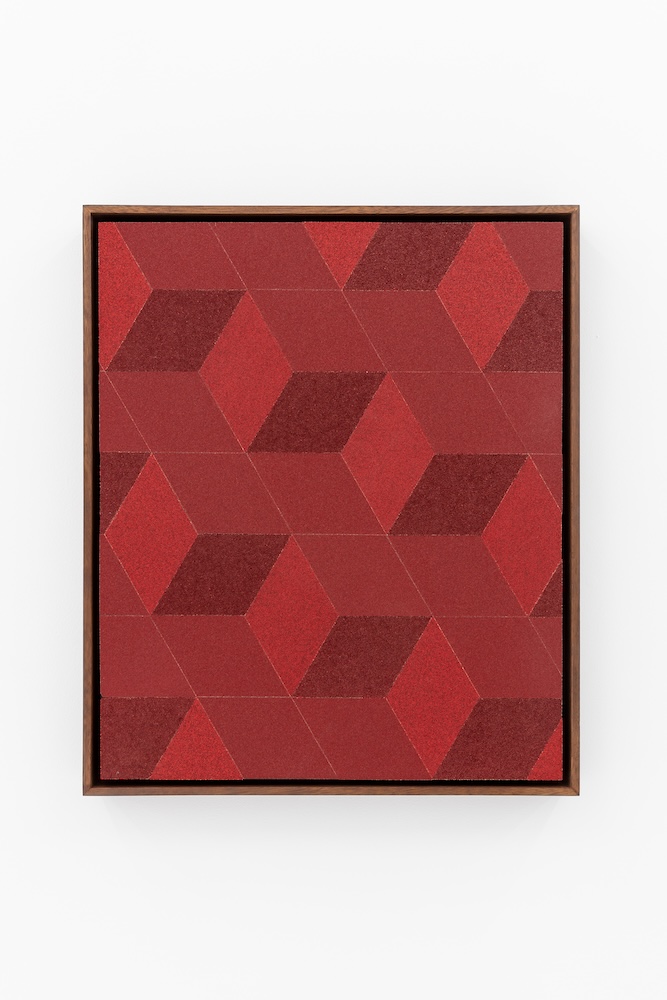
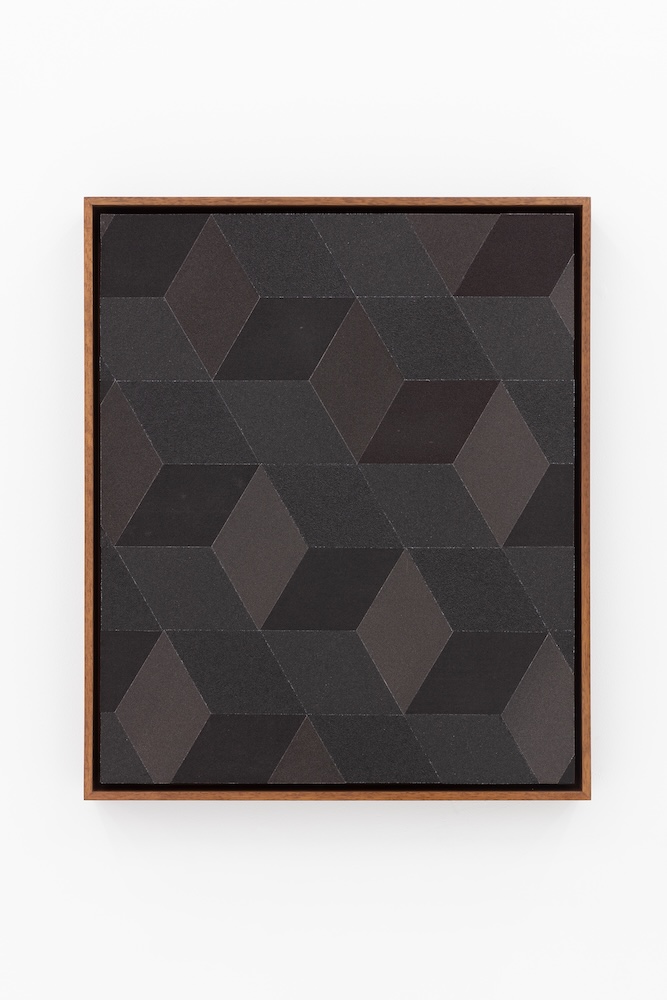
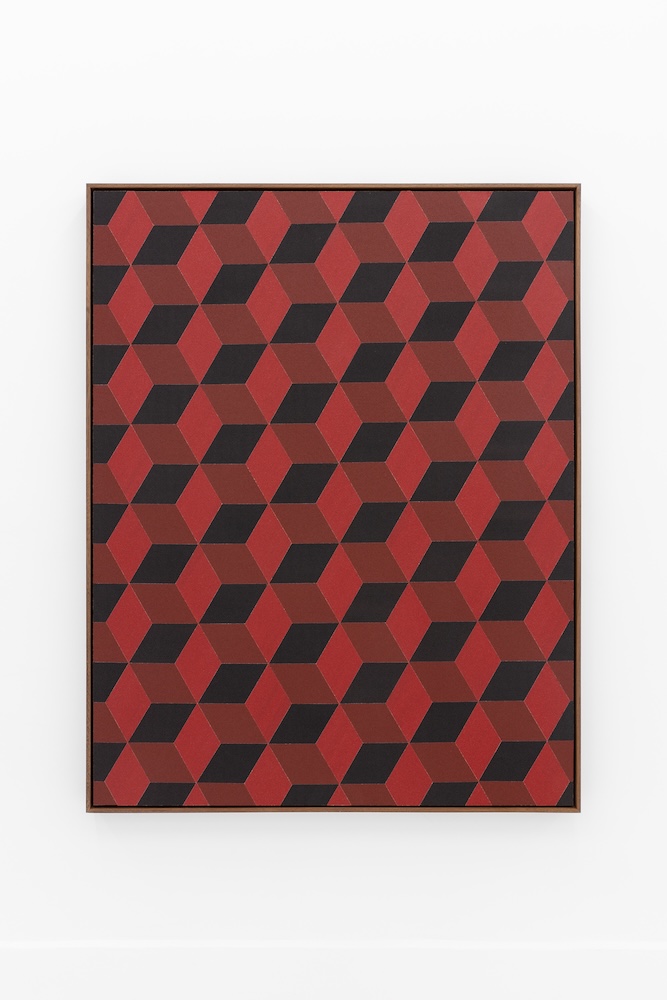
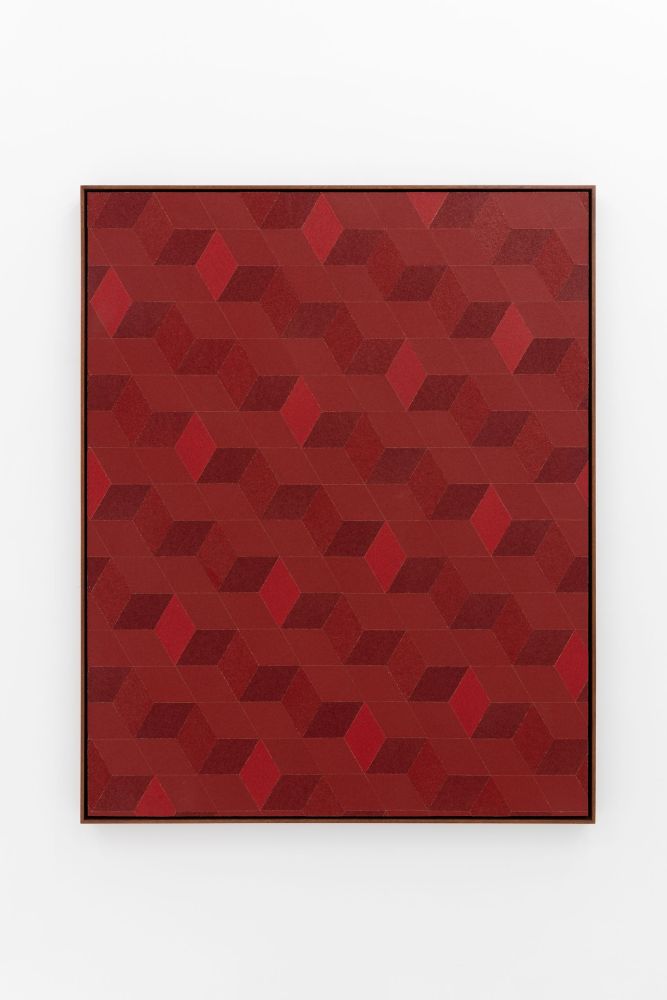
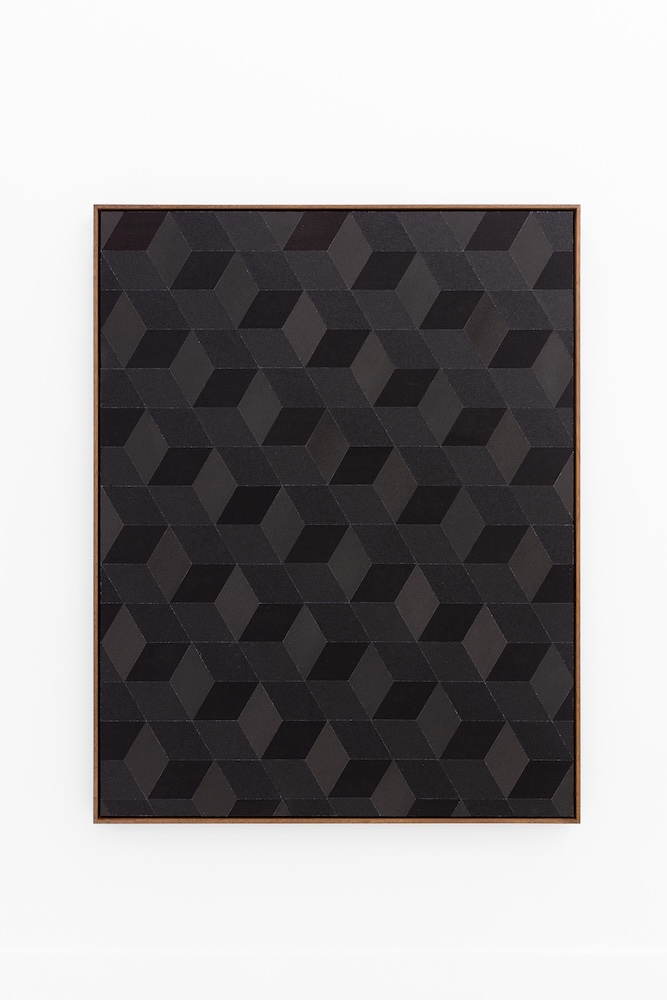
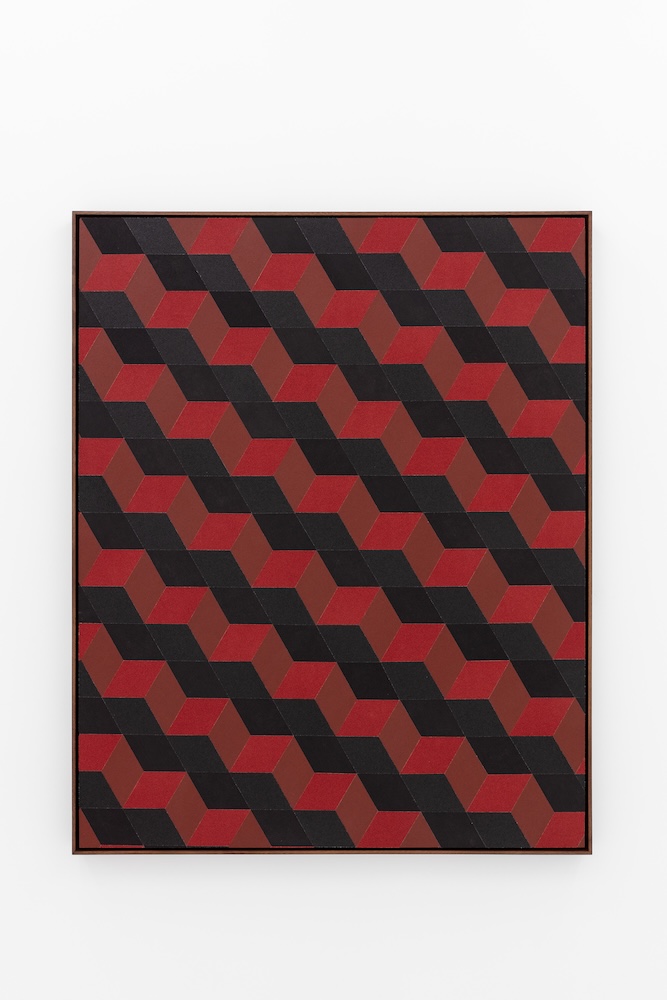
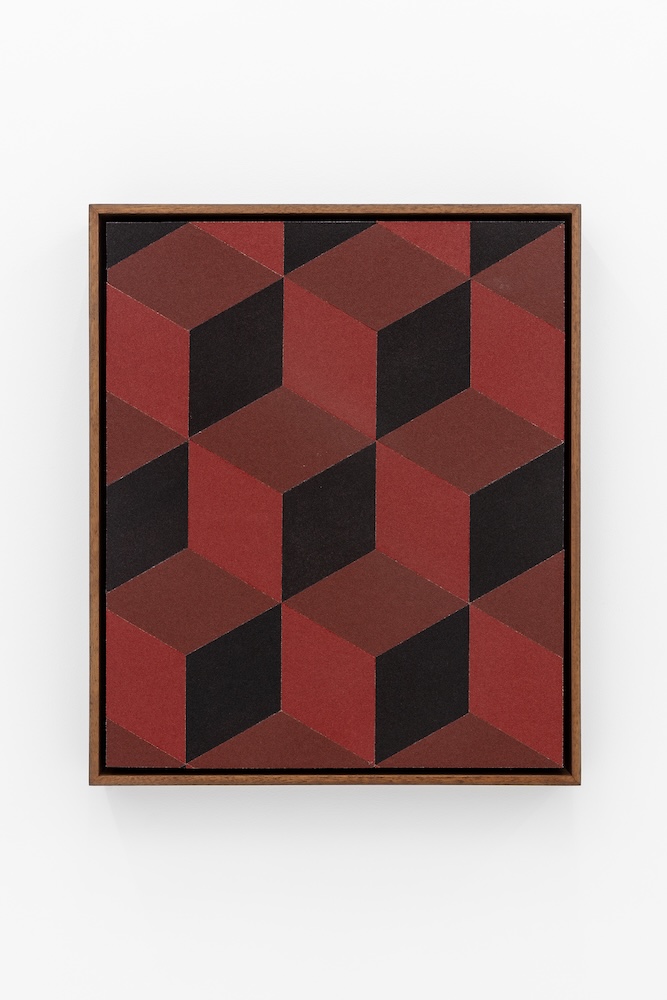
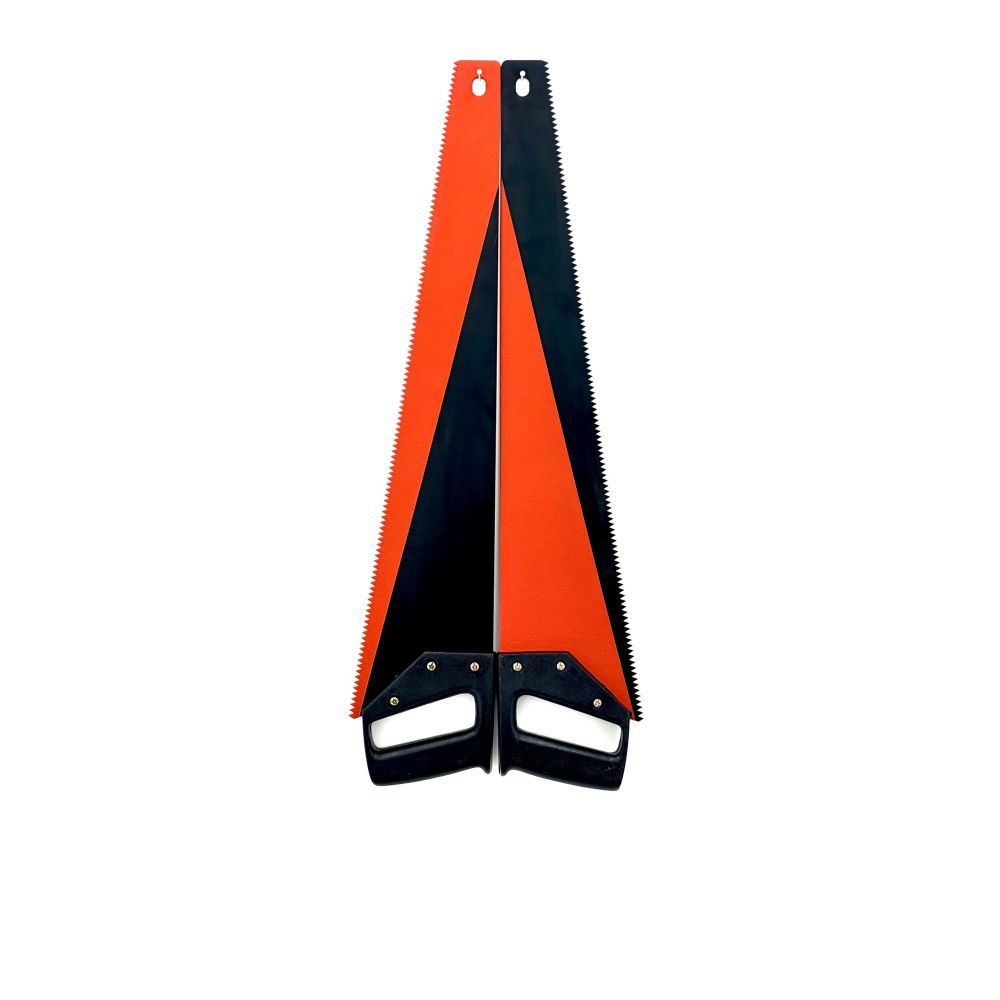
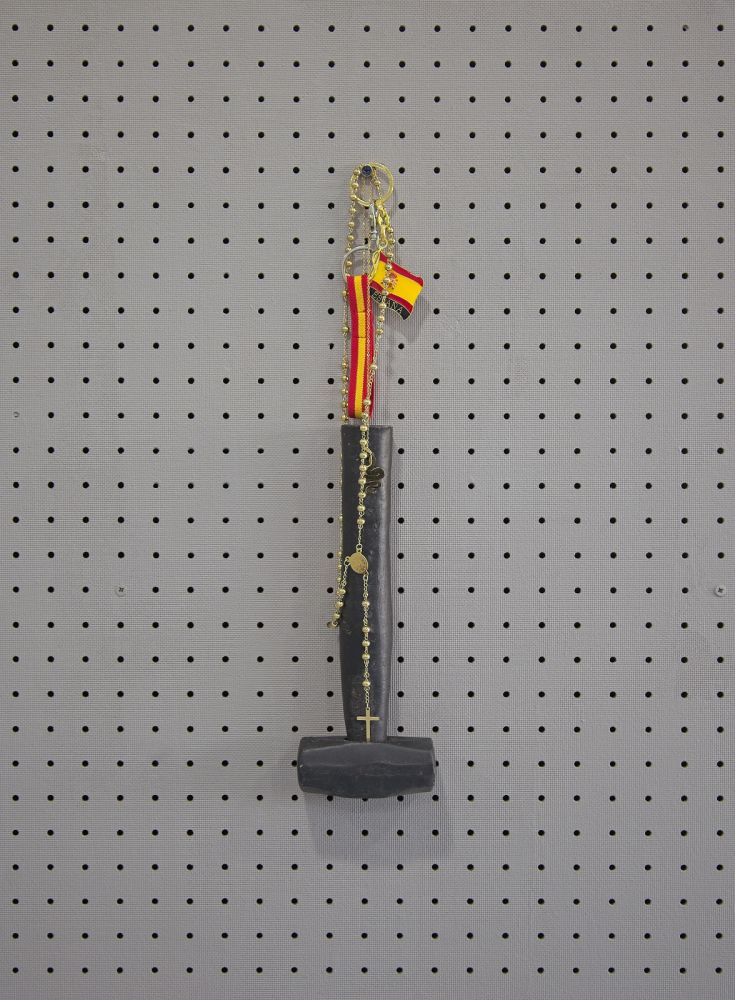
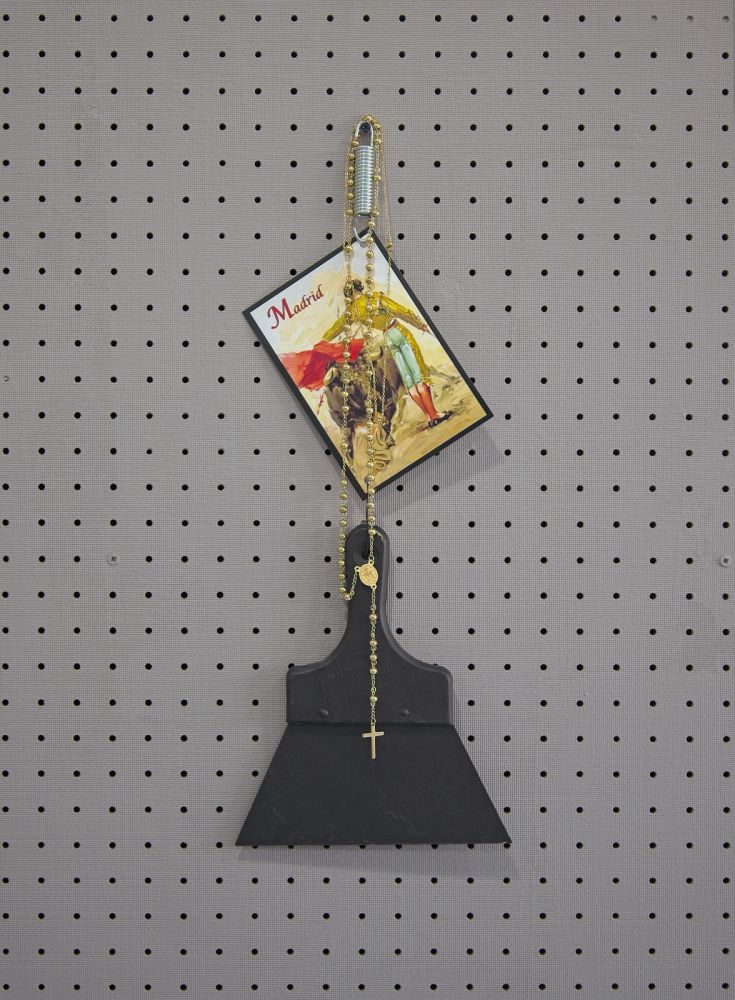
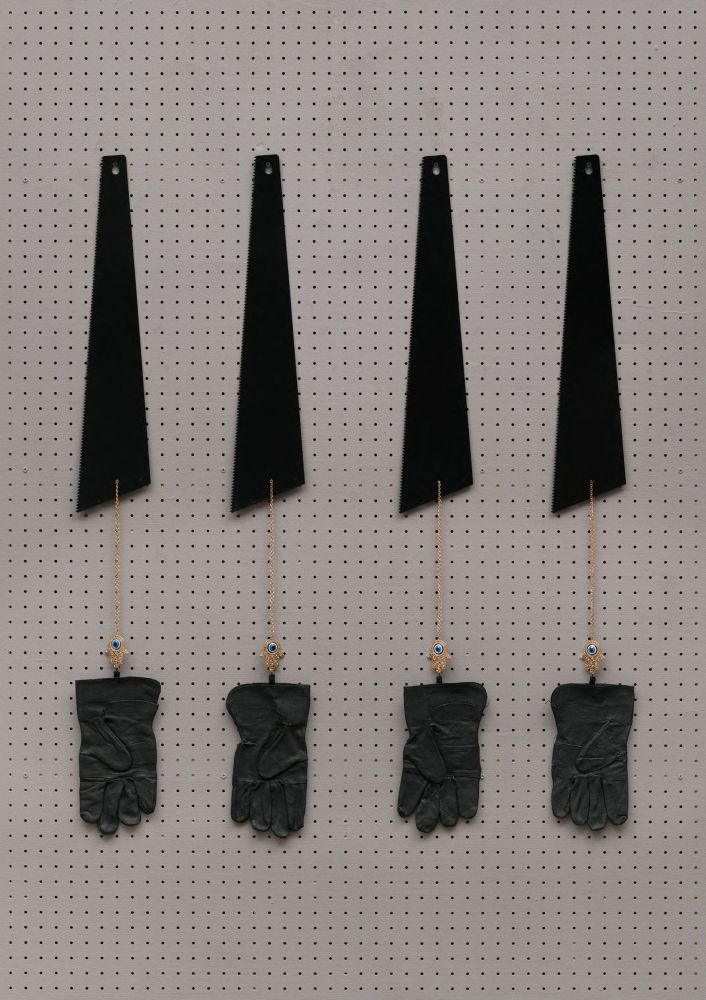
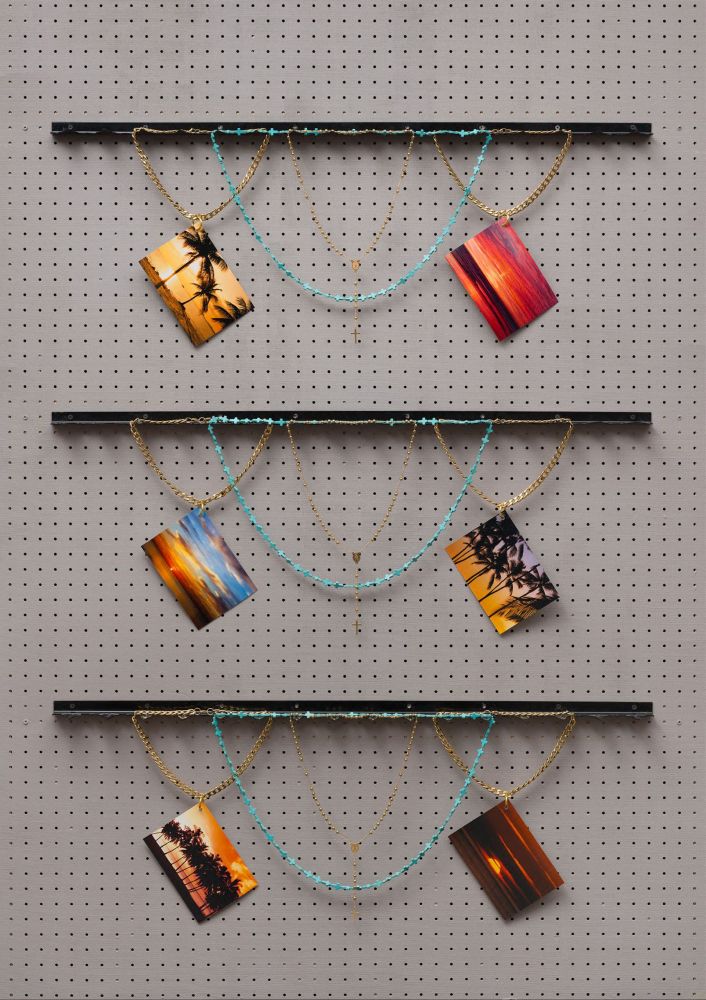
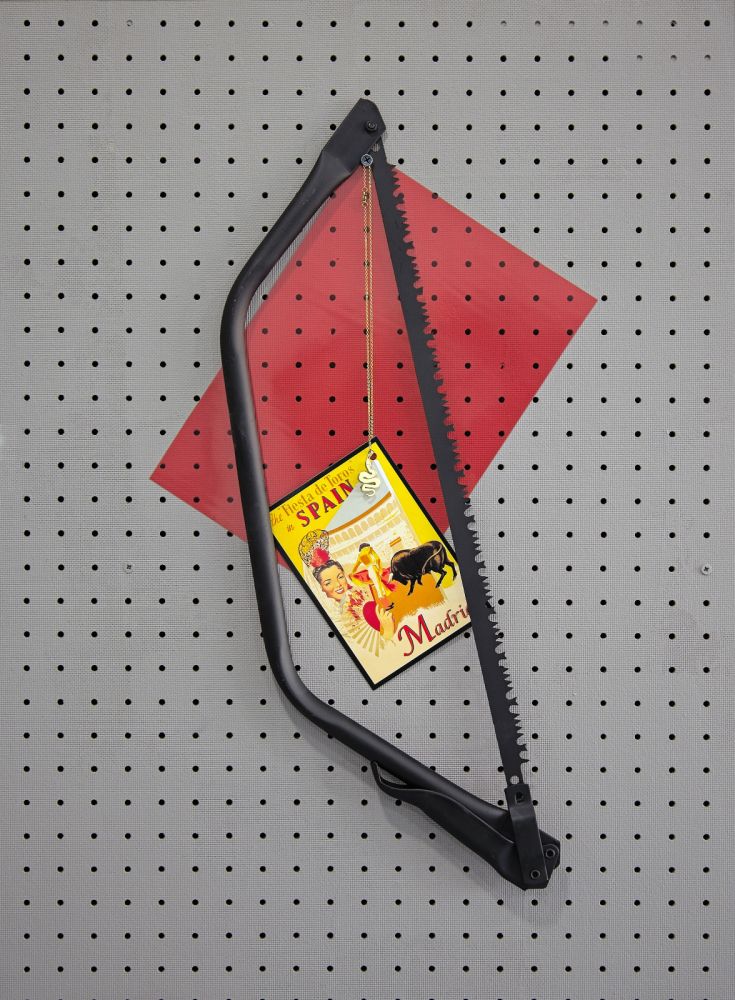
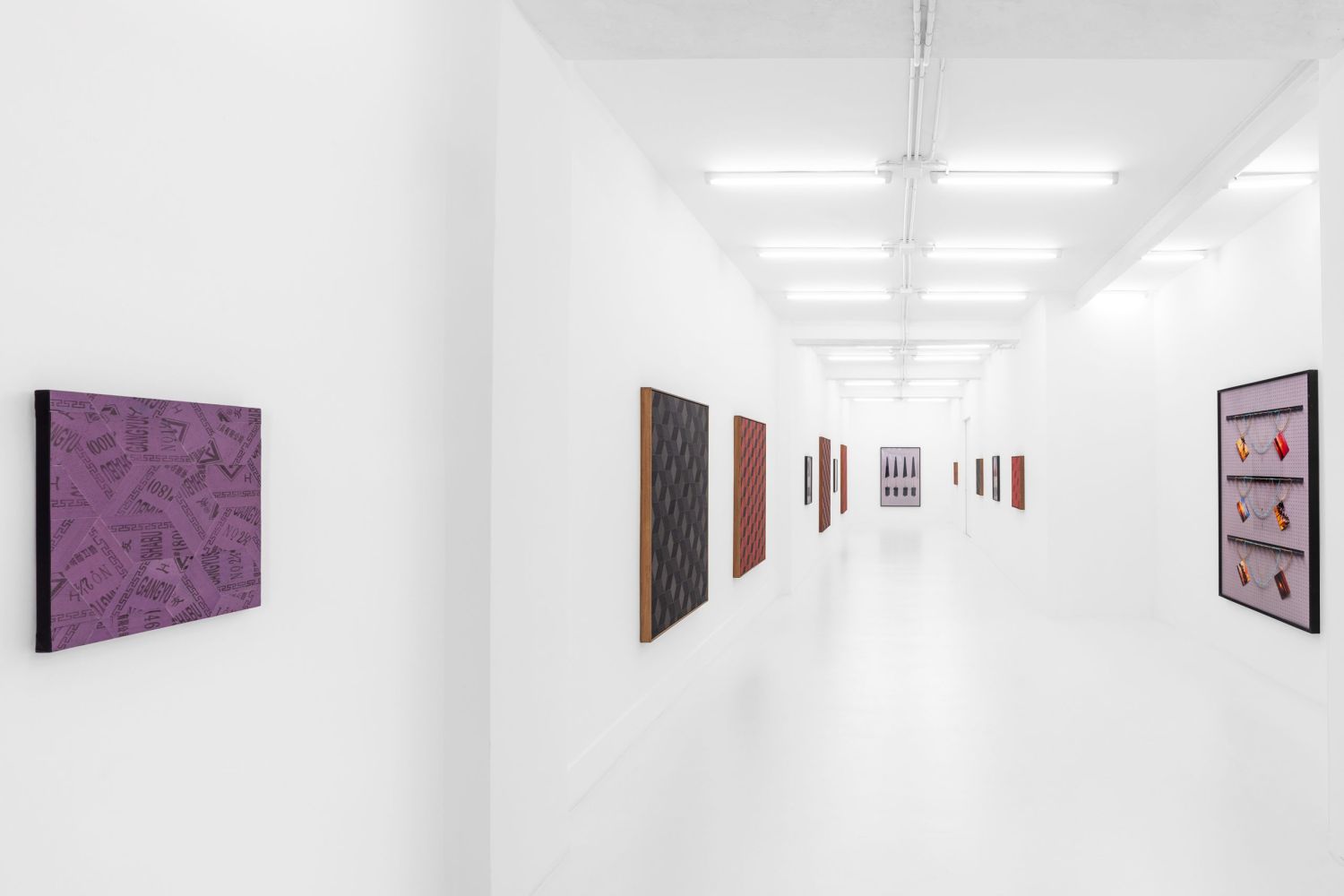
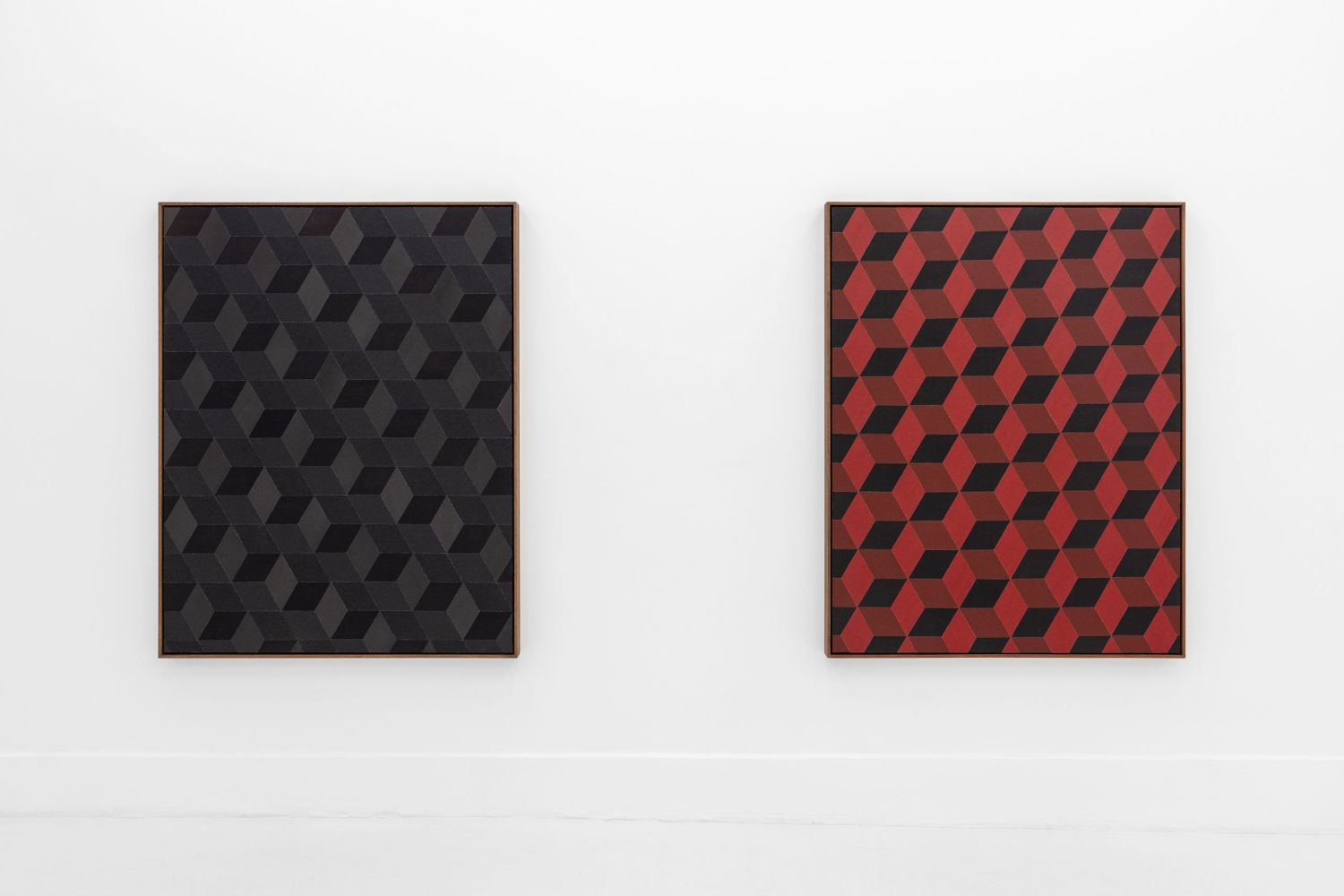
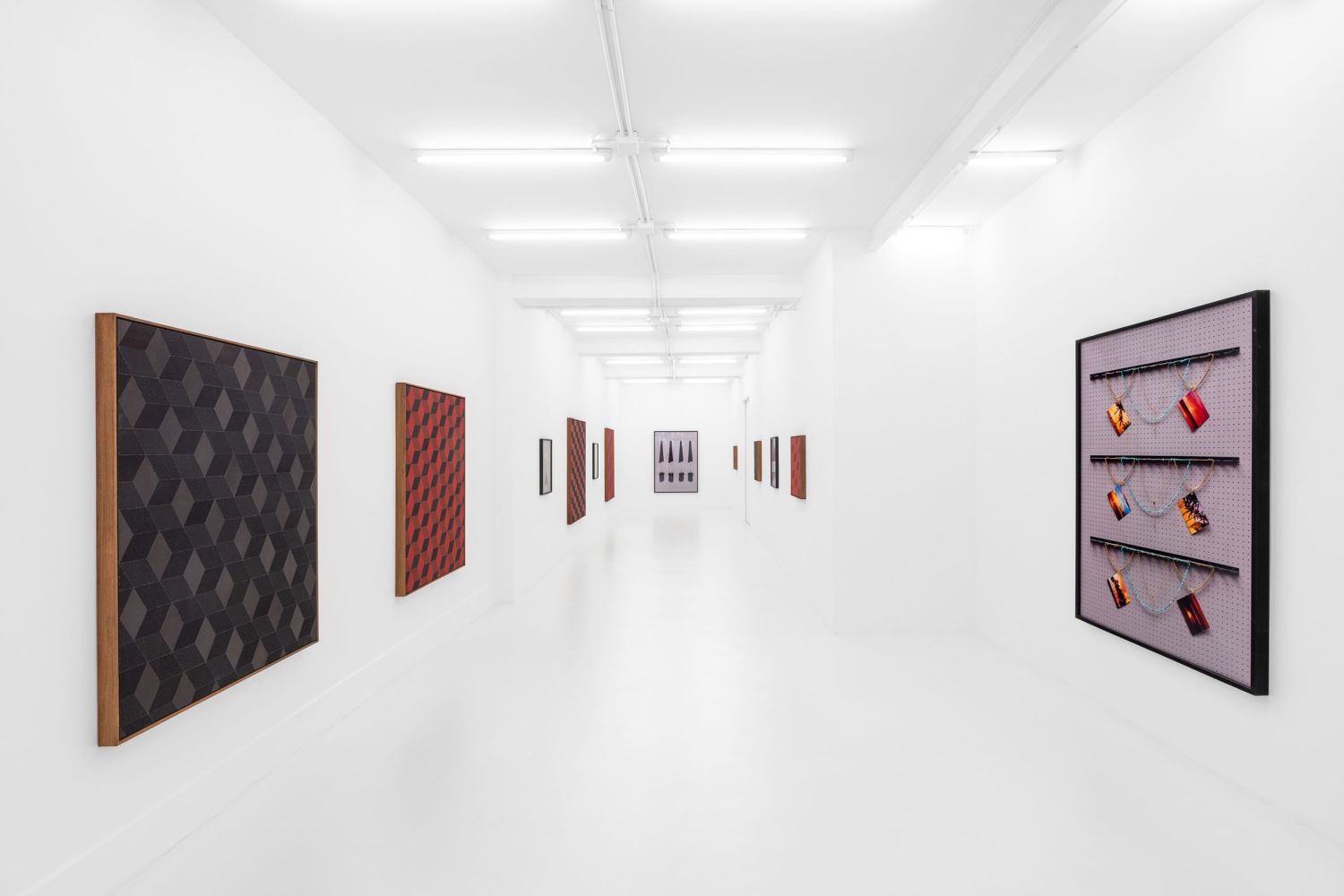
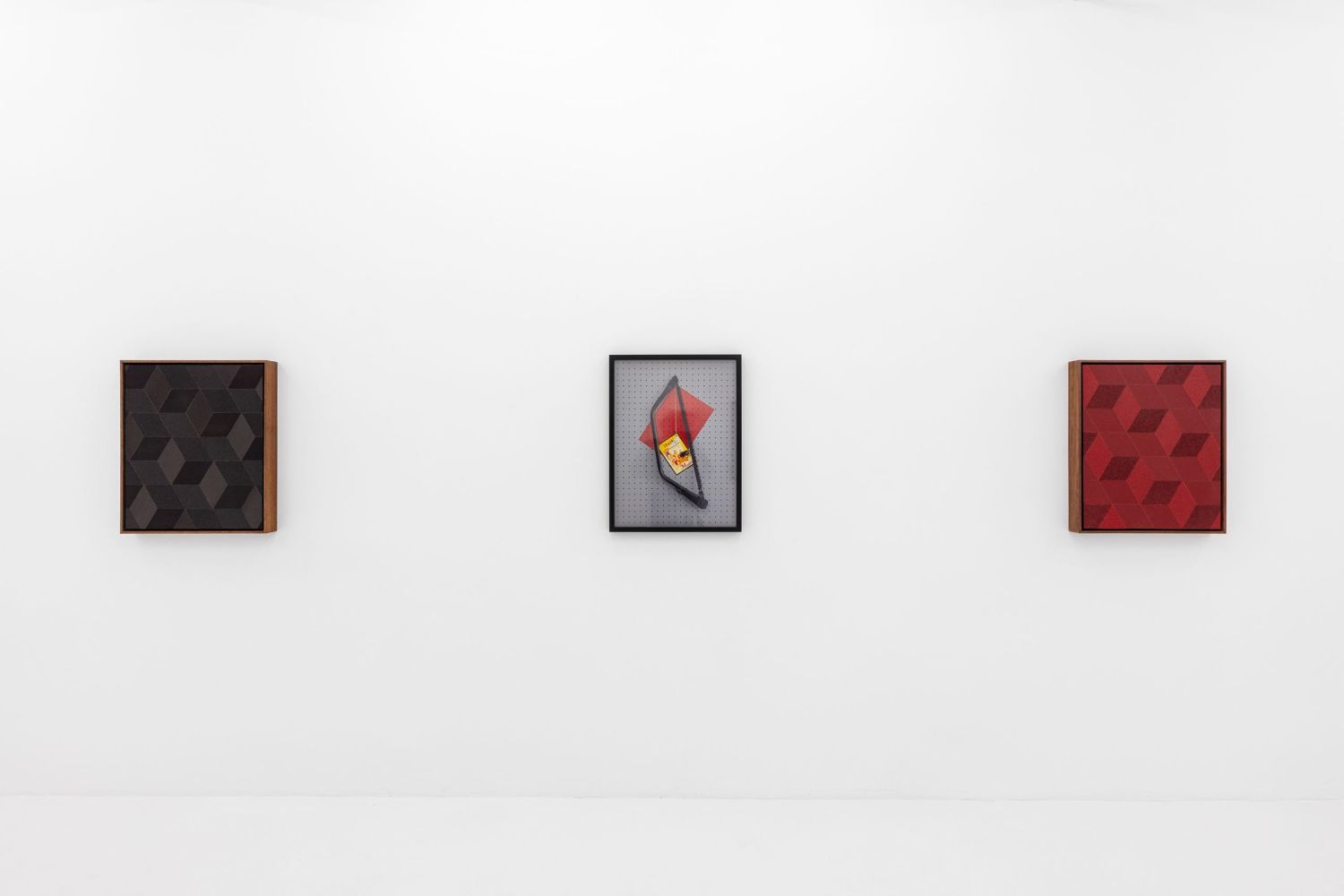
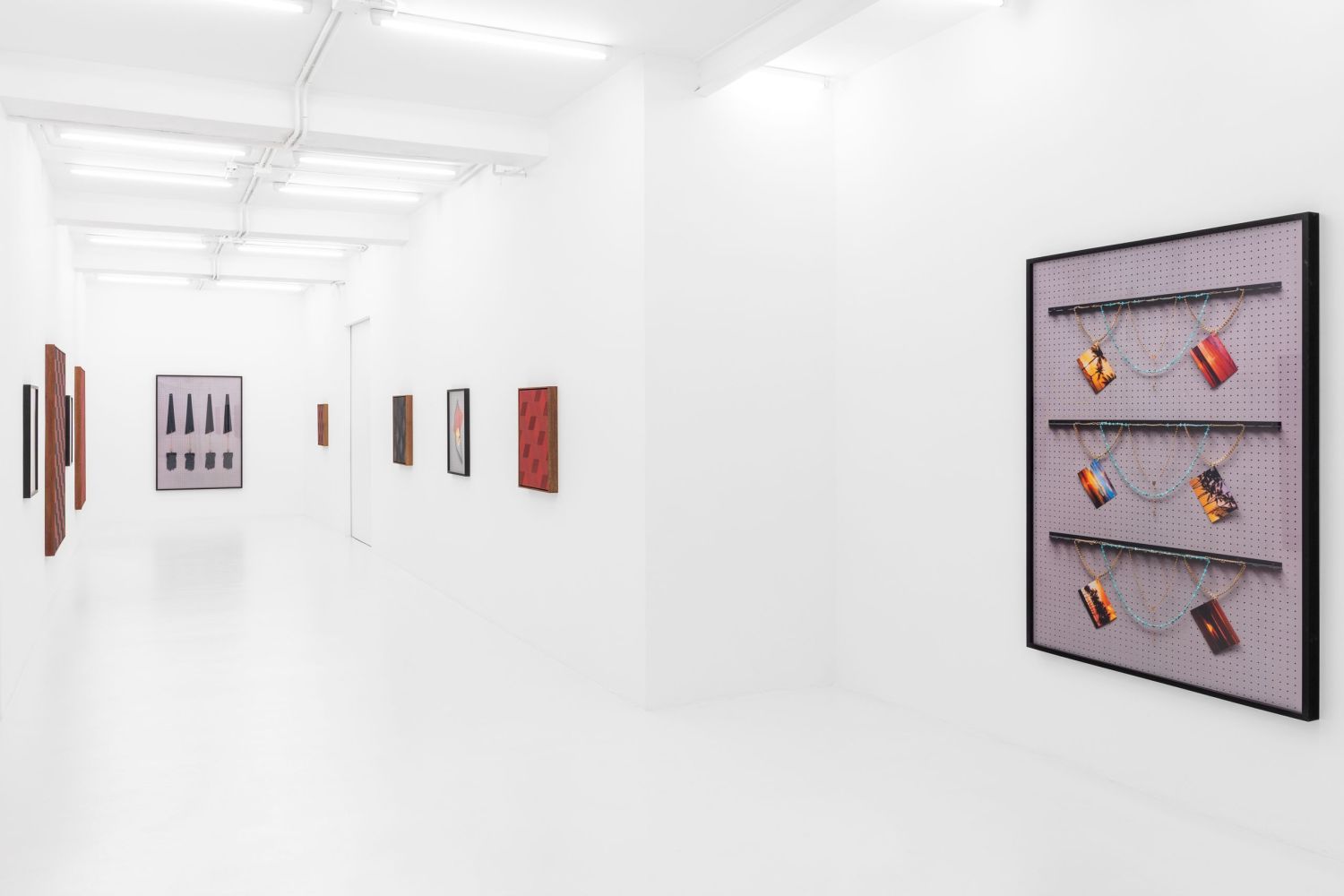
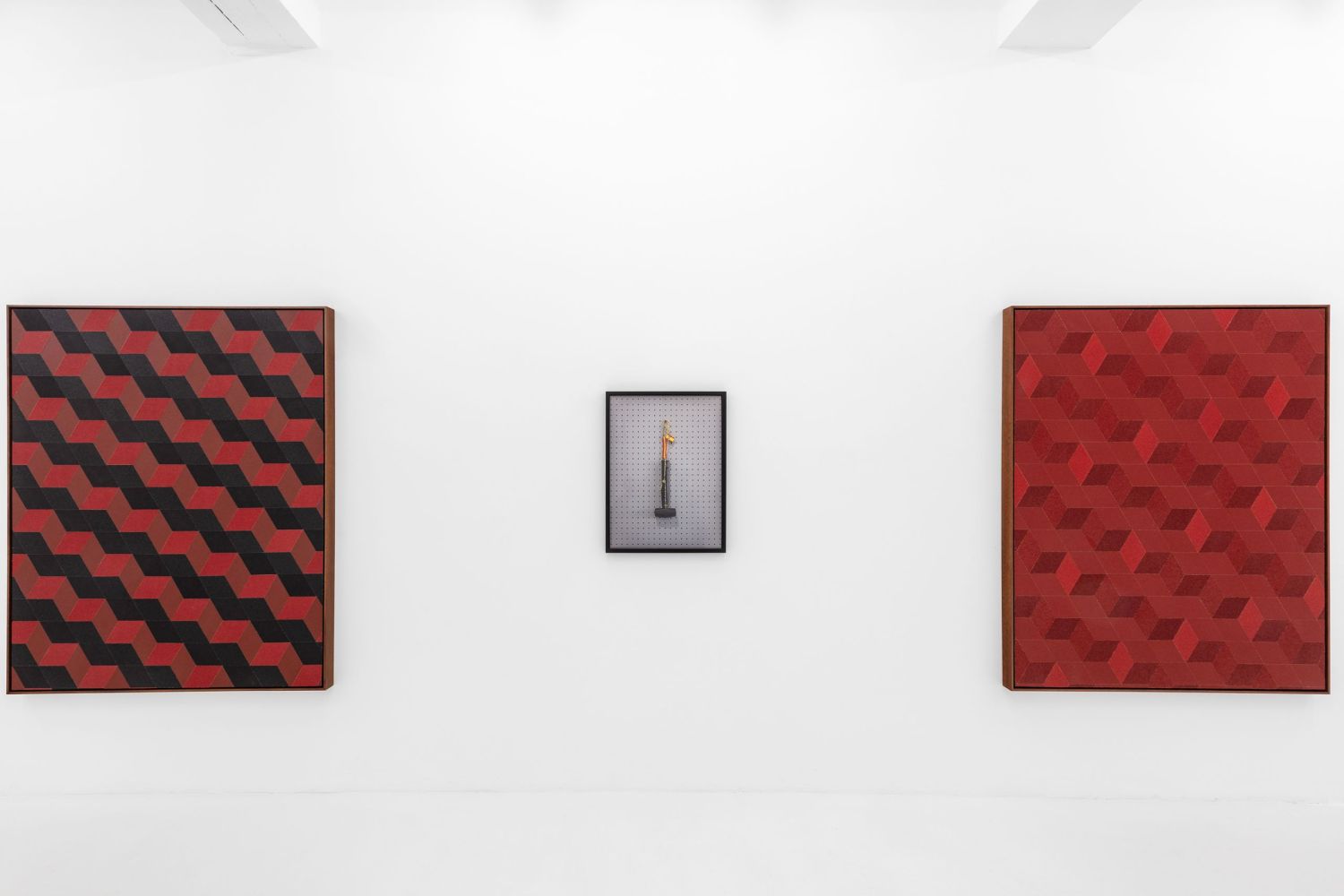
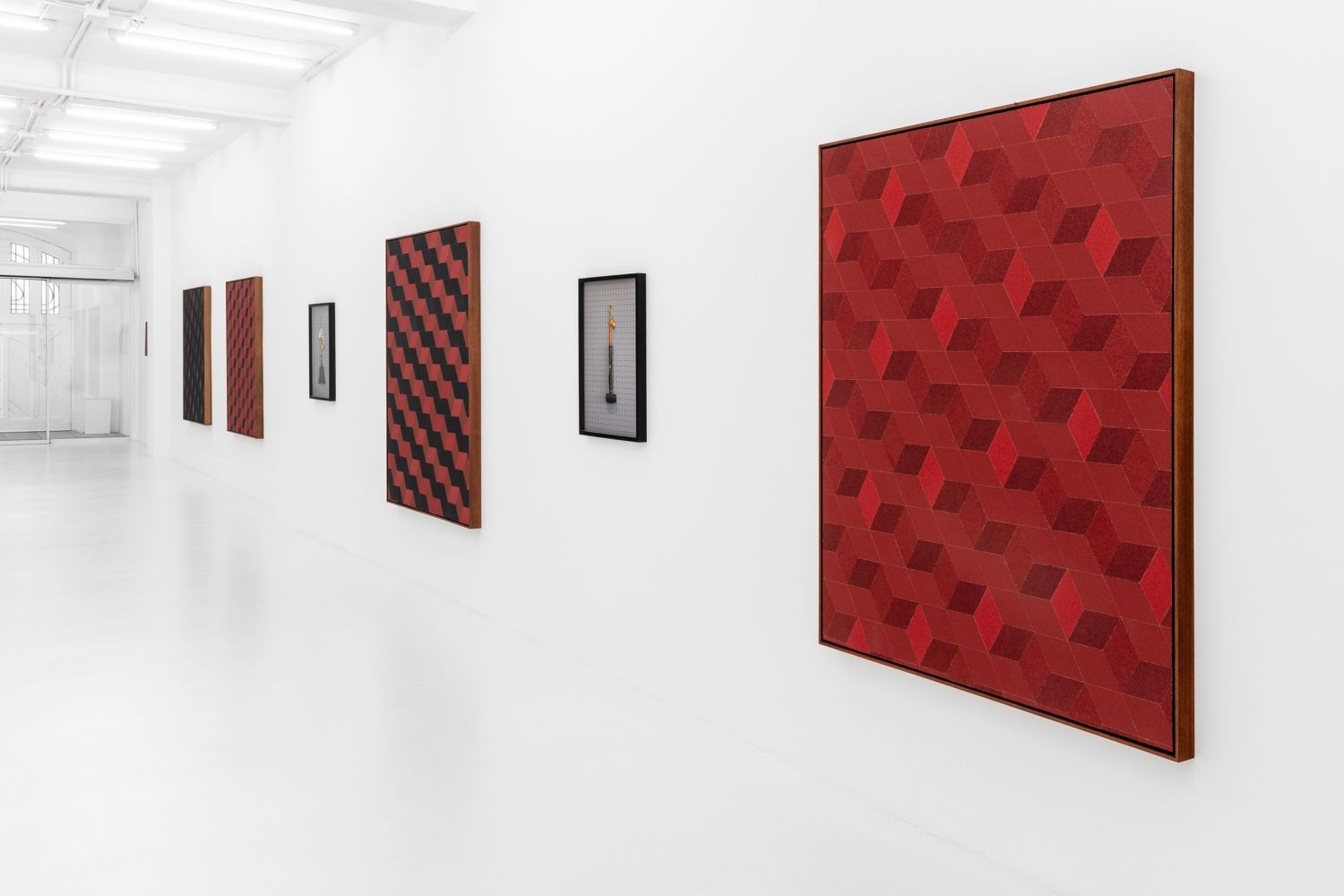
In HIPERASIA, the artist attempts to create a portrait of his everyday experience with the Chinese bazaars and shops that abound in the city of Madrid, as a kind of museum of contemporary curiosities. Patrick Hamilton has spent years turning to them in search of material and formal solutions for his various works in sculpture, photography, and painting. From this experience arise the two bodies of work exhibited in the gallery. On the one hand, Abrasive Paintings, compositions made with sandpaper in red and black tones that pay tribute to Neo-Geo art and Op Art of the 1970s and 1980s. On the other hand, he presents the photographic series Equilibrios, consisting of precarious constructions made with tools, costume jewelry, amulets, and tourist postcards that he then photographs, in the key of trompe-l’œil, with his camera.
Hamilton has conceived HIPERASIA as a series of essays with concerns that point in different directions, whether physiological, ideological, or related to consumption, and which are presented from a perspective halfway between ethnography and anthropology, pointing to organic and symbolic processes in which questions of temporality, aesthetics, and cultural and social banalization underlie.
LUGAR, VALOR, UTILIDAD… HIPERASIA DE PATRICK HAMILTON.
Cada cosa tiene su lugar, cada cosa tiene su valor y cada cosa tiene su utilidad. Estos tres principios son los mantras que sostienen la única certeza que nos queda en una sociedad de consumo. ¿Y la esperanza?, la esperanza es el escape al paraíso, es salir de este sistema de consumo y gozar de una vida tranquila y segura. Esta utopía liberadora quedó muy bien representada en la escena f inal de la película Carlito’s Way (Brian de Palma, 1993), donde un exconvicto que ha fracasado evadiendo todas las trampas que se le atraviesan para recaer en el crimen, va herido de bala camino al hospital y en ese corredor donde su conciencia se va apagando, recita un silencioso monólogo mientras observa la panorámica de una playa dorada “…se me acaban las fuerzas… lo siento, nena… hice lo que pude… no me queda nada más para dar… estoy cansado… nena… estoy cansado…” y el personaje se borra hasta dejar únicamente la ensoñación de aquel paraíso custodiado por los severos guardianes que lo mantuvieron toda la vida al este del Edén. Un trayecto por el corredor final como el de los niños sentados dentro de los carritos del supermercado, observando los colores vivos puestos en las estanterías bajo la luz blanca de los pasillos, mientras sus padres seleccionan el lugar, el valor y la utilidad de cada producto. Porque de eso se trata, ¿verdad?, de convencernos que no formamos parte del ciclo utilitario de la obsolescencia y el deshecho.
Luego de conversar con Patrick Hamilton acerca del título de esta exposición, concluimos que HIPERASIA, así con mayúsculas, sería el nombre indicado:
1. Porque la cantera de la que extrae sus materiales es una tienda de productos importados de China.
2. Porque el prefijo hiper tiene un significado polivalente, es exceso, es supremacía, es expansión y es totalidad.
3. Porque Asia desde hace cinco décadas ocupa todo de forma invisible, ¿Acaso no es un precepto taoísta que la grandeza es la simplicidad de lo pequeño?
Hamilton me lo planteaba de la siguiente forma, “los verdaderos espacios que registran la vida contemporánea son precisamente estos bazares chinos, donde los objetos son los testimonios más absolutos de esta relación entre el lugar, valor y utilidad de las cosas”. Siguiendo el hilo de estas ideas entiendo todas las posibilidades que nos ofrece para un momento tan complejo como el que está viviendo Occidente, guerra comercial incluida. El arte contemporáneo recurre obsesivamente a la autorreferencia, pero en realidad el mundo está pasando muy lejos de los espacios controlados por la narrativa dominante. El trabajo dentro de estas enormes fábricas creó un nuevo término, el subproletariado. Estas mismas manos que ensamblan juguetes o herramientas o adornos de sala o artículos para jardinería son la prueba más evidente que ya no existe ninguna labor que pueda valorarse como mano de obra especializada. Digámoslo así, los objetos carecen de nobleza y su valor de costo está muy por debajo de lo que podrían costar de ser fabricados en España o en cualquier otro país europeo. Curiosamente estos objetos van a dar a las casas de los millones de desempleados o trabajadores subcontratados alrededor del mundo. Aquello que quita el salario y ahoga la economía es consumido por las personas que más sufren por esta crisis. Muy paradójico. Desde hace dos décadas Hamilton viene investigando toda esta relación entre la economía y la memoria visual del presente. Desde el paisaje vinculado a la extracción de materia prima en Chile, la formación y modos de operar del neoliberalismo, hasta su reflexión acerca de un HIPER mundo de artículos que nos sobrepasan, su obra mantiene un hilo de coherencia.
Quiero hacer énfasis en el trato tan particular que Hamilton da a sus obras, todas concluidas con sus propias manos y sin la mediación de un asistente. Esta cualidad me resulta sumamente interesante al ejercer con su propia fuerza de trabajo la conclusión de una obra de compleja elaboración y con resultados tan exactos, tan obsesivamente acabados. Traza una simetría que muestra al objeto tal como lo ha encontrado, las lijas, en un patrón de cuadros o cubos que atraen directo al ojo del espectador como una trampa. Podemos decir que rescata los objetos de su propia obsolescencia para introducirlos dentro de un lenguaje visual para el que no fueron hechos. Podemos hablar de antipoemas y artefactos, tal como el poeta -también chileno- Nicanor Parra que descartaba la autorreferencialidad y el romanticismo quejumbroso de la poesía, para crear un lenguaje sin el chantaje sentimental de la tristeza, un poema que fuera casi una ecuación donde no existe sobrante sino pura expansión de palabras e imágenes, recuperando la nobleza de lo anónimo, de lo coloquial, de lo banal y de lo patético. Dentro de esta exposición están los pequeños tesoros, esos collares y amuletos, esas joyas falsas, esos pequeños paisajes turísticos encadenados que me hacen pensar en el escape al paraíso. Son cosas que colocamos para que el encierro no nos vuelva locos, lo paradójico es que los ponga dentro de la herramienta misma, como si todo lo que nos motivara fuera la promesa inconclusa de una salida, de una puerta hacia la libertad, de un de verdad os digo que estarás conmigo en el paraíso. Esta obra retoma la visión del arte ruso de la década del Veinte, cuando la utopía revolucionaria no había sido castrada por el Soviet, y tanto Malévich como Vértov o Ajmátova o Prokofiev disolvían la frontera entre la literatura y el diseño o la pintura y los oficios. La tradición vanguardista chilena es una heredera absoluta de estos diálogos y los extiende como una verdad propia, es el único lugar en el mundo donde la tradición es la vanguardia. Hamilton es heredero de esta forma de pensamiento visual donde cada objeto precario (una lija, una postal, un amuleto, una espátula, un guante de obrero) se ubican dentro de una obra perfectamente organizada.
Para concluir este ensayo quisiera subrayar que una obra donde se cierran ciclos y se abren posibilidades es algo urgente dentro del sistema del arte contemporáneo. Lo que hemos llamado arte se hace muy remoto y demasiado autorreferencial, hoy en día parece rehén de los discursos o de las polaridades aparentes. Perseguimos las sombras de la modernidad. Construimos oraciones como callejones oscuros para defender algo que necesita una explicación. En el caso de la obra de Hamilton, su versatilidad permite una discusión acerca de la vida invisible de las ciudades, de quienes las habitan, de quienes trabajan en ellas, de quienes poseen y de quienes carecen. La nobleza del arte se sostiene en la posibilidad de ser un testimonio de época que siga hablando de esa cambiante permanencia de lo humano.
– Javier Payeras, CDMX, marzo 2026
PLACE, VALUE, UTILITY… HIPERASIA BY PATRICK HAMILTON.
Everything has its place, everything has its value, and everything has its utility. These three principles are the mantras that sustain the only certainty we have left in a consumer society. And hope? Hope is the escape to paradise, it is leaving this system of consumption and enjoying a calm and secure life. This liberating utopia was very well represented in the final scene of the film Carlito’s Way (Brian de Palma, 1993), where an ex-convict who has failed while trying to evade all the traps that come his way and pull him back into crime, is on his way to the hospital with a gunshot wound, and in that corridor where his consciousness is fading, he recites a silent monologue while observing the panorama of a golden beach “…I’m running out of strength… I’m sorry, baby… I did what I could… I have nothing left to give… I’m tired… baby… I’m tired…” and the character fades away until only the dream of that paradise remains, guarded by the severe sentinels who kept him all his life east of Eden. A journey through the final corridor like that of children sitting inside shopping carts, observing the bright colors placed on the shelves under the white light of the aisles, while their parents select the place, the value, and the utility of each product. Because that’s what it’s about, right?, convincing ourselves that we are not part of the utilitarian cycle of obsolescence and waste.
After discussing with Patrick Hamilton the title of this exhibition, we concluded that HIPERASIA, in uppercase, would be the appropriate name:
1. Because the quarry from which he extracts his materials is a shop of products imported from China.
2. Because the prefix hyper has a polyvalent meaning, it is excess, it is supremacy, it is expansion and it is totality.
3. Because Asia has invisibly occupied everything for five decades, isn’t it a Taoist precept that greatness is the simplicity of the small?
Hamilton put it to me in the following way, “the true spaces that register contemporary life are precisely these Chinese bazaars, where objects are the most absolute testimonies of this relationship between the place, value and utility of things”. Following the thread of these ideas I understand all the possibilities it offers us for a moment as complex as the one the West is experiencing, including the trade war. Contemporary art obsessively resorts to self-reference, but in reality the world is passing very far from the spaces controlled by the dominant narrative. Work inside these enormous factories created a new term, the subproletariat. These same hands that assemble toys or tools or living room ornaments or gardening items are the clearest proof that there is no longer any labor that can be valued as skilled work. Let’s put it this way, objects lack nobility and their cost value is far below what they would cost if they were manufactured in Spain or in any other European country. Curiously, these objects end up in the homes of millions of unemployed or subcontracted workers around the world. That which takes away wages and suffocates the economy is consumed by the people who suffer most from this crisis. Very paradoxical. For two decades Hamilton has been researching this entire relationship between the economy and the visual memory of the present. From the landscape linked to the extraction of raw materials in Chile, the formation and modes of operation of neoliberalism, to his reflection on a HYPER world of items that overwhelm us, his work maintains a thread of coherence.
I want to emphasize the very particular treatment that Hamilton gives to his works, all finished with his own hands and without the mediation of an assistant. This quality is extremely interesting to me, as he uses his own labor force to complete a work of complex elaboration with such exact, obsessively finished results. He draws a symmetry that shows the object as he has found it, the sandpapers, in a pattern of squares or cubes that pull directly at the viewer’s eye like a trap. We can say that he rescues objects from their own obsolescence to introduce them into a visual language for which they were not made. We can speak of antipoems and artifacts, like the poet -also Chilean- Nicanor Parra who discarded the self-referentiality and the plaintive romanticism of poetry, to create a language without the sentimental blackmail of sadness, a poem that would be almost an equation where there is no surplus but pure expansion of words and images, recovering the nobility of the anonymous, of the colloquial, of the banal and of the pathetic. Within this exhibition are the small treasures, those necklaces and amulets, those fake jewels, those small tourist landscapeschained together that make me think of the escape to paradise. They are things we place so that confinement does not drive us mad, the paradox is that he places them inside the very tool itself, as if everything that motivates us were the unfinished promise of an exit, of a door toward freedom, of a truly I tell you that you will be with me in paradise. This work takes up the vision of Russian art of the twenties, when the revolutionary utopia had not yet been castrated by the Soviet, and both Malevich and Vertov or Akhmatova or Prokofiev dissolved the boundary between literature and design or painting and crafts. The Chilean avant-garde tradition is an absolute heir to these dialogues and extends them as a truth of its own, it is the only place in the world where tradition is the avant-garde. Hamilton is heir to this form of visual thought where each precarious object (a piece of sandpaper, a postcard, an amulet, a spatula, a worker’s glove) is placed within a perfectly organized work.
To conclude this essay I would like to underline that a work in which cycles are closed and possibilities are opened is something urgent within the system of contemporary art. What we have called art becomes very remote and overly self-referential, nowadays it seems hostage to discourses or apparent polarities. We chase the shadows of modernity. We construct sentences like dark alleys to defend something that needs an explanation. In the case of Hamilton’s work, its versatility allows for a discussion about the invisible life of cities, of those who inhabit them, of those who work in them, of those who possess and those who lack. The nobility of art is sustained in the possibility of being a testimony of its time that continues to speak of that changing permanence of the human.
– Javier Payeras, CDMX, March 2026