
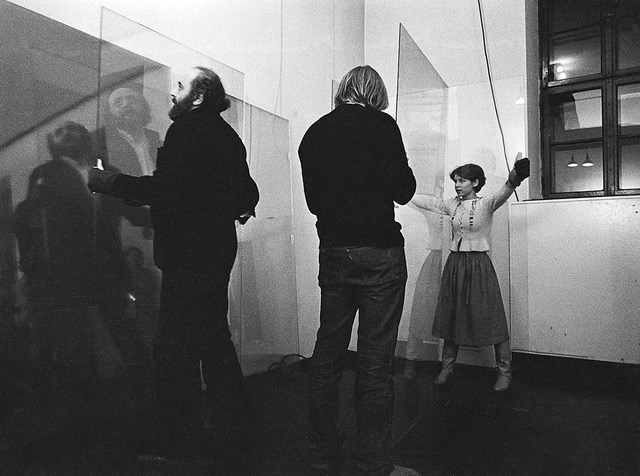


1.Fragile Balance (Danger)
Trafó Gallery, Budapest
23.1. – 22.3.2026
Opening: Friday, January 23rd, 19h
The exhibition Fragile Balance (Danger) has a dual purpose: on the one hand in this sense in a manner similar to a motto or a slogan it aims to call attention to and place in a contemporary context the most monumental of Miklós Erdély’s glass-panel installations; «Fragile Balance (Danger)», which was originally presented in Kraków in 1981, while on the other hand, it attempts to reactivate Erdély’s legacy through contemporary artworks that reflect on his intellectual and artistic heritage. Every element of the exhibition is thus an experiment with uncertain outcomes, exploring whether it is possible to dislocate the art of this remarkable artist of the Hungarian and Central-Eastern European neo-avant-garde from its invisibility, and how his ouvre can continue to live on through the artworks of contemporary artists.
2.Andreas Fogarasi – Fábrica de Ossos
Lehmann Contemporary, Porto
7.2. – 3.4.2026
Opening: Saturday, February 7th, 16-20h
3. Andreas Fogarasi – Branding the Public (Austria)
Museum in Progress, Vienna
From 23.1.2026
As part of the project raising flags by museum in progress – the 39th contribution to the series – Andreas Fogarasi has designed four flags, each featuring a well-known Austrian visual symbol. The selected signs represent the visual identity of state and state-affiliated institutions during the respective period and are deeply embedded in the collective memory: Austrian Airlines (1972–2003), ORF (1968–2002), ÖBB (1974–2004), Made in Austria (1978–2004).
By removing these signs from their original functional contexts and transferring them onto the form of the flag, Fogarasi transforms them into emblematic signs of national self-representation. The flags do not function as carriers of explicit messages; rather, they operate as visual condensations of institutional presence, economic power and state-driven identity formation. Their apparent neutrality simultaneously points to the saturation of public space by logos and signets that promise orientation and mark belonging.
The flags unfold their impact in the tension between everyday familiarity and symbolism. Fogarasi’s intervention makes visible the extent to which national identity is mediated through design, brand aesthetics and visual recognisability. At the same time, it reveals how strongly these forms of representation are bound to specific historical moments. All four pictograms were created in the years of social upheaval following 1968 and fell out of use in the period of increasing deregulation shortly after the turn of the millennium. Fogarasi thus sets signal markers of collective temporal experience. In this way, the flags become mobile projection surfaces for questions of representation, authority and the role of public institutions. At the same time, they invite reflection on the transformation of visual languages in the context of social and state change over time.
Andreas Fogarasi (*1977 in Vienna) is an Austrian artist who lives and works in Vienna. In his conceptual practice he engages with architecture, design and urban symbols, as well as with the visible and invisible codings of cultural identity. His works explore how social values, power relations and national self-images are inscribed in forms, surfaces and signs. Fogarasi frequently employs strategies of appropriation, reduction and displacement to render familiar visual systems newly legible.